Does that imply you already know your target at the end of this dive?
Yes. It's a minibrot at a zoom of around 10
324 of which I have (so far) only a crummy low-res preview.
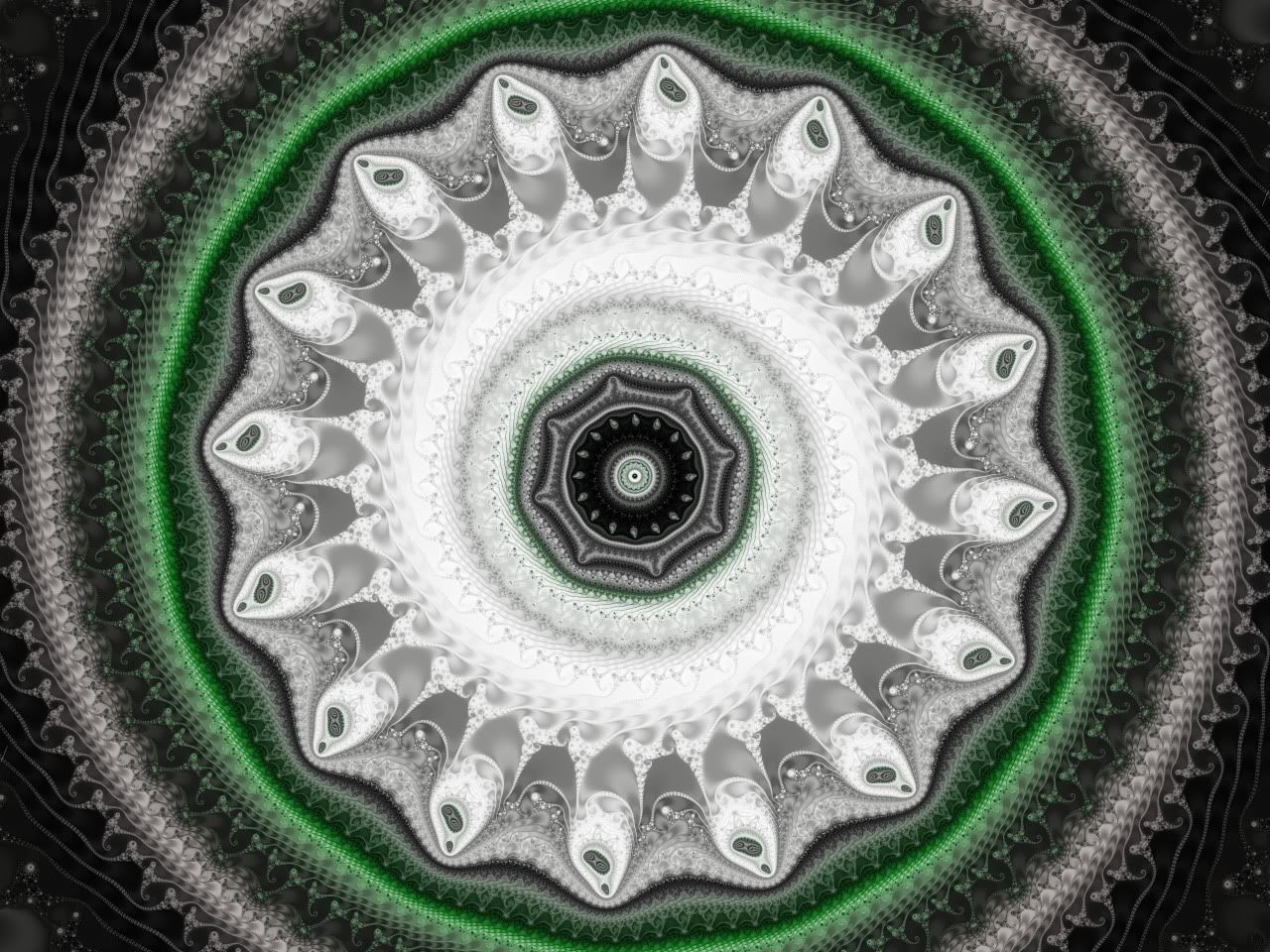
I've just now realized the images have periodic rotational symmetry of a multiple of 4. Are you using it to speedup calculation?
Yes, but only with low-res previews generated without it and full-res (or higher!) "spot checks", generating a key-hole sized bit of the image and a rotated copy to see that they are pixel-exact in terms of filament positions and everything. Any inaccuracies must be no more than what one gets from having a finite resolution sampling grid anyway.
Many of the images have subtle departures from the apparent symmetry in them, and those don't use the speedup, or use a lower symmetry that is exact (ex. 4-fold instead of an apparent 8-fold).
The symmetry is approximate and local -- zoom far enough and the minibrot itself and its immediate environs are not rotationally symmetrical, for instance -- but there are annular regions where the deviations from perfect symmetry are much tinier than the errors introduced by other sources, like the sampling grid or the arithmetic precision being used, and all of those error sources are kept too small (combined) to visibly impact the image.
Note also: some of the images have 2-fold rotational symmetry, though all of those are earlier now. In fact, the last few with merely fourfold symmetry are coming up, after which it's 8-fold-plus until the asymmetry of the minibrot begins to make its effects known, which will not happen until the final few images.
The technical math of it can be sketched as follows: far from the set, the mapping becomes well-approximated by
z ->
z2, which just doubles angles and squares distances. Shapes around a deep minibrot, deep enough but not too close to the minibrot in scale, are doubled in a way that's very close to exact (for deep minibrots) because of this well-approximation, producing the two, four, etc. fold symmetries approaching the minibrot. The smoothed iterations calculations avoid seams in the coloring by the same math, actually; if you use it with a low bailout (like 4) you see seams, and if you make the bailout huge (10
4, say) the seams disappear. The symmetry works similarly, but a superdeep minibrot behaves as the full set with a very huge bailout (as it's very small compared to even a bailout of 4, unlike the full set which barely fits inside that).
And with that bit of technical dissertation out of the way:


 May 06, 2012, 11:00:04 PM


 Dilber MC Theme by HarzeM