Logo by Pauldelbrot - Contribute your own Logo!

END OF AN ERA, FRACTALFORUMS.COM IS CONTINUED ON FRACTALFORUMS.ORG

it was a great time but no longer maintainable by c.Kleinhuis contact him for any data retrieval,
thanks and see you perhaps in 10 years again

this forum will stay online for reference
News: Follow us on Twitter
 
*
Welcome, Guest. Please login or register. December 01, 2025, 07:46:22 AM


Login with username, password and session length


The All New FractalForums is now in Public Beta Testing! Visit FractalForums.org and check it out!


Pages: [1] 2   Go Down
  Print  
Share this topic on DiggShare this topic on FacebookShare this topic on GoogleShare this topic on RedditShare this topic on StumbleUponShare this topic on Twitter
Author Topic: Supermandelbrot and Superjulia imaging  (Read 2813 times)
0 Members and 1 Guest are viewing this topic.
matsoljare
Fractal Lover
**
Posts: 215


WWW
« on: October 16, 2008, 11:43:39 PM »

I don't know if anyone has tried this before, but i've considered a new way of rendering Mandelbrot and Julia sets for any formula that i'm sure have great visual potential.

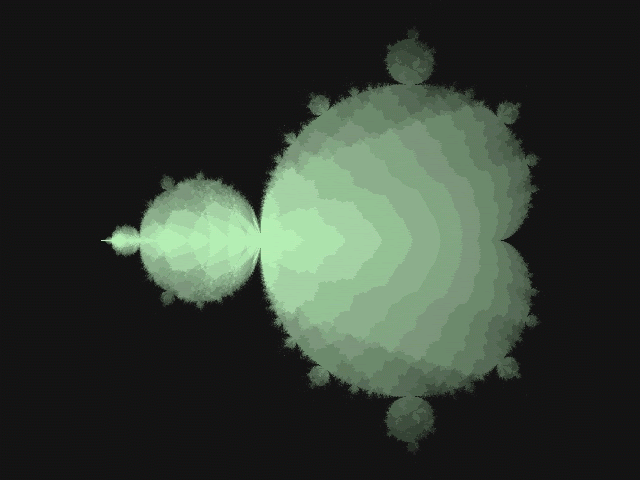
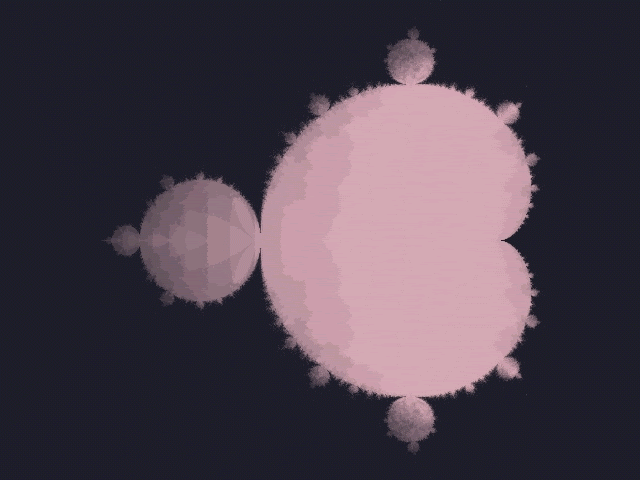
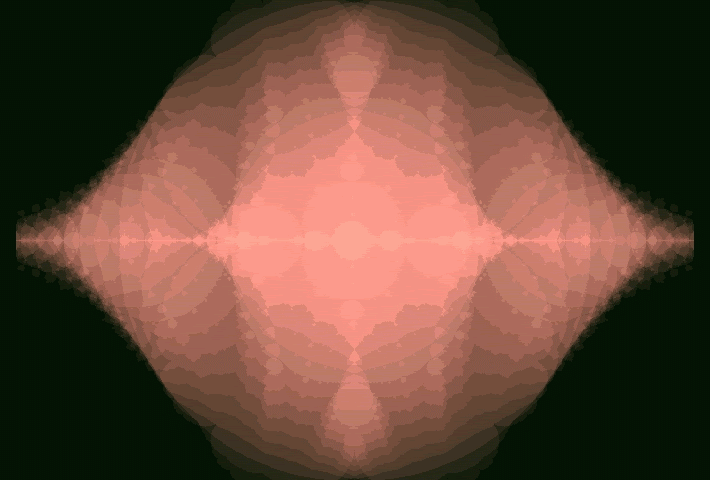
For each pixel on a Mandelbrot set, instead of rendering just one point and determining the outcome, render an entire Julia set with the values given by the pixel, and use the amount of attracted vs escaping points to decide the color. The same could be done the other way around instead, with a Mandelbrot set being rendered for each point on the plane.

It can also be thought of as "every" Julia or Mandelbrot set (within a limited space and with limited resolution) put on top of each other and mixed.

This would of course be very computationally expensive, but possibly worth the work.

Another variant is where simply a "line" of values are rendered for each pixel. The images below are a very simple attempt at rendering that with a very slow QBasic program, and can probably be done in much better ways.

Perhaps this could be called Supermandelbrot and Superjulia, with the 2-dimensional version being Hyper-ditto?


Logged
lycium
Fractal Supremo
*****
Posts: 1158


WWW
« Reply #1 on: October 17, 2008, 12:23:04 PM »

heya  afro

the method you describe and the results you've shown seem kinda similar to something i did a while back, have a look at these animation: http://fractographer.com/anims/julia2_x264.avi

you'll need the x264 codec (or vlc player), which you can get with the (excellent) ffdshow plugin at http://x264.nl
« Last Edit: October 17, 2008, 12:25:26 PM by lycium » Logged

matsoljare
Fractal Lover
**
Posts: 215


WWW
« Reply #2 on: October 17, 2008, 02:39:29 PM »

That appears to be similar, though it might have been more interesting if you had used a regular "black white" rendering instead. I believe those are using "lines" of values rather than the full plane? Though it strikes me you could get the same result by simply making a video of a Julia set with changing values and applying a motion blur effect, which is what it looks like...

I made some experiments in QBasic using a random value for each pixel to spread it evenly through the full real and imaginary plane, and though the result was very noisy, it seems rather promising. I'm sure someone's thought of it before though.

Actually the reason i thought about this in the first place was when reading about some J and M sets for alternate formulas, where it was noted that the Julia set of certain formulas wasn't very related to the Mandelbrot set, so it couldn't be used for a "map" in the same way, and i thought there must be another way to construct a useful map for the Julia sets in this manner.
Logged
lycium
Fractal Supremo
*****
Posts: 1158


WWW
« Reply #3 on: October 17, 2008, 02:59:20 PM »

correct, it is (a form of) motion blur; actually what it is, is a moving time-integral of the julia images produced by a trip around the main lobe of the mandelbrot set against a weird periodic kernel function, so that it forms something of a moving time-derivative. this is computed numerically using monte carlo integration, which is the scientific basis of your qbasic experiments  afro
Logged

lkmitch
Fractal Lover
**
Posts: 238


« Reply #4 on: November 13, 2008, 01:01:27 AM »

Here's a variation that works with both inside and outside pixels:  Color by the fraction of times that the real part of z is less than the imaginary part of z at the end of the iteration.  I call this example, "dust storm."   smiley

Kerry


* dust storm.jpg (190.08 KB, 800x600 - viewed 385 times.)
Logged
matsoljare
Fractal Lover
**
Posts: 215


WWW
« Reply #5 on: November 13, 2008, 08:53:34 PM »

That's not bad looking, but what software did you use for this?
Logged
lkmitch
Fractal Lover
**
Posts: 238


« Reply #6 on: November 14, 2008, 04:06:51 PM »

That's not bad looking, but what software did you use for this?

It's a coloring formula that I wrote for Ultra Fractal.  When I've finished it, I'll upload it to the Ultra Fractal formula database.  Until then, here's another trial.

Kerry


* nov13-a.jpg (112.9 KB, 750x600 - viewed 361 times.)
Logged
matsoljare
Fractal Lover
**
Posts: 215


WWW
« Reply #7 on: November 15, 2008, 04:07:58 AM »

Wow, that looks like it's burning! Absolutely fantastic!
Logged
lkmitch
Fractal Lover
**
Posts: 238


« Reply #8 on: November 21, 2008, 04:45:08 AM »

Thanks!
Logged
matsoljare
Fractal Lover
**
Posts: 215


WWW
« Reply #9 on: November 12, 2009, 12:10:34 PM »

I'm disappointed that it seems like none of you here are very interested in this. I thought i had run into something really big here....
Logged
lkmitch
Fractal Lover
**
Posts: 238


« Reply #10 on: November 12, 2009, 04:00:16 PM »

I'm disappointed that it seems like none of you here are very interested in this. I thought i had run into something really big here....

I think it's a neat idea and have used it in some images. But, you can't tell what will resonate with people when. Just keep working on your ideas and putting them out there--someone will be interested.
Logged
stigomaster
Guest
« Reply #11 on: November 12, 2009, 04:50:21 PM »

The top two images really just look like different perturbations of the m-set superimposed on top of each other. But I understand that is not the way you computed it, so I guess it is just an interesting connection.
Logged
bib
Global Moderator
Fractal Senior
******
Posts: 2070


At the borders...


100008697663777 @bib993
WWW
« Reply #12 on: November 12, 2009, 09:50:13 PM »

Hi
I don't remember what colouring formula I used for this picture, but I just put it here because of graphical similarities.
Logged

Between order and disorder reigns a delicious moment. (Paul Valéry)
matsoljare
Fractal Lover
**
Posts: 215


WWW
« Reply #13 on: November 14, 2009, 10:04:29 PM »

The top two images really just look like different perturbations of the m-set superimposed on top of each other. But I understand that is not the way you computed it, so I guess it is just an interesting connection.

No, that IS exactly what it is supposed to be. But the ones i rendered are only a limited few, while i intend the "complete" (within reason) set of Mandelbrot or Julia sets to be combined.
Logged
stigomaster
Guest
« Reply #14 on: November 16, 2009, 02:27:48 PM »

All right then, I just got confused by the "Rendering an entire Julia set". I think I understand now, though.
Logged
Pages: [1] 2   Go Down
  Print  
 
Jump to:  

Related Topics
Subject Started by Replies Views Last post
Fractals Improve Imaging Performance Fractal News across the World Nahee_Enterprises 0 2206 Last post February 01, 2007, 09:42:58 PM
by Nahee_Enterprises
zebra imaging prints Format, Printing & Post Production marius 1 4969 Last post February 05, 2012, 07:19:51 PM
by harveyfloyd

Powered by MySQL Powered by PHP Powered by SMF 1.1.21 | SMF © 2015, Simple Machines

Valid XHTML 1.0! Valid CSS! Dilber MC Theme by HarzeM
Page created in 0.299 seconds with 24 queries. (Pretty URLs adds 0.011s, 2q)