|
Furan
|
 |
« Reply #270 on: November 01, 2012, 07:17:30 AM » |
|
This is incredible. These last images appear to be perfectly symmetrical, yet they have to have one way in, one way out, because the M-set is compact. I wonder if that property could be visualized somehow via animation.
|
|
|
|
|
 Logged
|
|
|
|
|
plynch27
|
|
« Reply #271 on: November 01, 2012, 05:55:08 PM » |
|
This is incredible. These last images appear to be perfectly symmetrical, yet they have to have one way in, one way out, because the M-set is compact. I wonder if that property could be visualized somehow via animation.
Interesting that you should mention that. I can think of one way, though I lack the video production skills to accomplish it and it might be trickier using partial-iteration renders. About 20 months ago -- at least according to the file's metadata -- a guy I met on YouTube extrapolated this image for me from one of my zoom videos: http://www.mediafire.com/view/?ashgvgk5ysp6xip -- it's well beyond the filesize cap for this forum, but it's only 7.5MB, jpeg, though, dimensions: 65500x503 px. It uses the mercator projection to show the entire zoom video all in one image. What I found interesting scrolling through it was that you could follow the very first filament that starts all the way to the left the whole way through the image to the right -- because of the properties of the mercator projection, when the filament disappears to the top or bottom, you can pick it right back up on the opposite side. This happens a lot due to spiraling. So, theoretically, if you highlighted this filament and made a video scrolling through the image, you'd be able to visualize that property. |
|
|
|
|
Logged
|
If you'd like to leave me a text message, my 11-digit phone number can be found in π starting at digit 224,801,520,878
((π1045,111,908,392) mod 10)πi + 1 ≈ 0
|
|
|
|
rollercoaster158
|
|
« Reply #272 on: November 01, 2012, 08:51:48 PM » |
|
I imagine that some kind of pixel interpolation similar to Fractal eXtreme's one picture rendered per zoom method could be used on these images. We then could use the resulting frames to stitch together and make a Mercator map along with a zoom movie. The only problem is that these images are zoomed in by a different factor each time, so we would need to find a way to compensate for that.
|
|
|
|
|
Logged
|
|
|
|
|
plynch27
|
|
« Reply #273 on: November 01, 2012, 09:06:23 PM » |
|
Luckily, each subsequent frame is visible in each current frame. To compensate for the arbitrary zooming, we'd just need an algorithm that can find each frame in the one before it -- e.g. a modified image-stitching algorithm -- and extrapolate from there.
|
|
|
|
|
Logged
|
If you'd like to leave me a text message, my 11-digit phone number can be found in π starting at digit 224,801,520,878
((π1045,111,908,392) mod 10)πi + 1 ≈ 0
|
|
|
|
rollercoaster158
|
|
« Reply #274 on: November 02, 2012, 01:33:53 AM » |
|
I like the idea, but I'm concerned all of the different sized images will mess up the resolution balance of the Mercator map and zoom movie. We could theoretically re-render the images in an exact X2 or X3 zoom factor per frame, but it has taken a long time to render these existing ones. I don't want to waste a bunch of already-rendered work.
|
|
|
|
|
Logged
|
|
|
|
|
Furan
|
|
« Reply #275 on: November 02, 2012, 01:31:51 PM » |
|
I wonder. Imagine a function t(z,n)=(0;1) giving every z on the M-set boundary a positional parameter t, something like counting the (total accumulated angle)/(the maximal angle possible to accumulate for nth iteration) but much more clever. Consistent with different number of iterations. (With a continuous inverse function).
"Positional parameter on the M-set boundary". Have you ever heard about anything like that?
EDIT: If valid, let us start a new topic for this problem.
|
|
|
|
« Last Edit: November 02, 2012, 01:54:03 PM by Furan »
|
Logged
|
|
|
|
|
plynch27
|
|
« Reply #276 on: November 02, 2012, 03:38:48 PM » |
|
I feel kind of dumb asking this favor, but the truth is I was more of a calculus follower in college. I never dabbled a whole lot in complex analysis. I was hoping you could do me a really huge favor and expand that notation into something more explicit, because I have no idea what's going on right there.  I'd greatly appreciate it. Cheers. |
|
|
|
|
Logged
|
If you'd like to leave me a text message, my 11-digit phone number can be found in π starting at digit 224,801,520,878
((π1045,111,908,392) mod 10)πi + 1 ≈ 0
|
|
|
|
Furan
|
|
« Reply #277 on: November 02, 2012, 10:18:42 PM » |
|
|
|
|
|
|
Logged
|
|
|
|
|
Pauldelbrot
|
|
« Reply #278 on: November 04, 2012, 04:55:02 AM » |
|
Thanks for the various compliments. Yes, large regions around deep minibrots can be almost exactly symmetrical, with the distortions being very small compared to the scale of the image pixels. And indexing around the perimeter is known as "external angles" or "external rays". It's similar to, but not quite the same as, what decomposition coloring does. 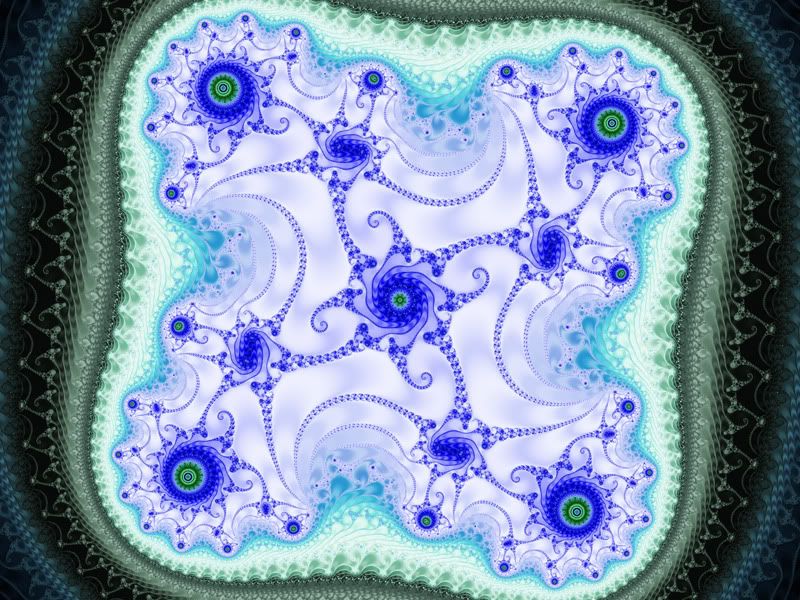 |
|
|
|
|
Logged
|
|
|
|
|
Pauldelbrot
|
|
« Reply #279 on: November 04, 2012, 10:16:34 AM » |
|
|
|
|
|
|
Logged
|
|
|
|
|
Pauldelbrot
|
|
« Reply #280 on: November 04, 2012, 03:01:59 PM » |
|
|
|
|
|
|
Logged
|
|
|
|
|
Pauldelbrot
|
|
« Reply #281 on: November 04, 2012, 10:57:46 PM » |
|
|
|
|
|
|
Logged
|
|
|
|
|
plynch27
|
|
« Reply #282 on: November 05, 2012, 04:36:04 AM » |
|
|
|
|
|
|
Logged
|
If you'd like to leave me a text message, my 11-digit phone number can be found in π starting at digit 224,801,520,878
((π1045,111,908,392) mod 10)πi + 1 ≈ 0
|
|
|
|
Pauldelbrot
|
|
« Reply #283 on: November 05, 2012, 10:33:44 AM » |
|
Thanks.  |
|
|
|
|
Logged
|
|
|
|
|
Pauldelbrot
|
|
« Reply #284 on: November 05, 2012, 02:18:04 PM » |
|
|
|
|
|
|
Logged
|
|
|
|
|


 May 06, 2012, 11:00:04 PM


 Dilber MC Theme by HarzeM