|
matsoljare
|
 |
« on: February 13, 2012, 05:47:50 PM » |
|
I wonder if anyone has any ideas for 2D fractals using only integers, rather than non-integer numbers? Each number, or combination of numbers would be represented by a pixel, and would only extend "outwards" to larger numbers.... has anyone thought of any formulas that work like this?  Just as i wrote this, i realize there is at least one- Pascal's triangle, but i'm sure there are other variations of this.  |
|
|
|
|
 Logged
|
|
|
|
DarkBeam
Global Moderator
Fractal Senior

Posts: 2512
Fragments of the fractal -like the tip of it
|
|
« Reply #1 on: February 13, 2012, 06:45:42 PM » |
|
Now we only need fractals using letters...  |
|
|
|
|
Logged
|
No sweat, guardian of wisdom!
|
|
|
|
matsoljare
|
|
« Reply #2 on: February 23, 2012, 07:38:07 PM » |
|
There is in fact a 3D form of Pascal's triangle, called Pascal's Pyramid of course: 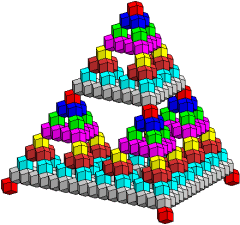 |
|
|
|
|
Logged
|
|
|
|
lkmitch
Fractal Lover

Posts: 238
|
|
« Reply #3 on: February 23, 2012, 08:47:09 PM » |
|
There are lots of integer-based sets that admit fractal-like shapes. Many come from number theory. See the Online Encyclopedia of Integer Sequences for some fractal sequences of integers. I've done a fair amount of work with integer fractals. My "permutations" series is based on permutations of integers, for example: http://www.kerrymitchellart.com/gallery25/permutations1.html
|
|
|
|
|
Logged
|
|
|
|
|
kram1032
|
|
« Reply #4 on: March 23, 2012, 09:50:21 AM » |
|
There is also those: http://en.wikipedia.org/wiki/Algebraic_integer - if you want to count them,then: http://en.wikipedia.org/wiki/Algebraic_number  The red dots in that one are all Algebraic Integers in the complex plane. (Roots of polynomials with ONLY integers in them and the highest order term preceeded by a 1) The image above that instead colors by degree of the used polynomials. |
|
|
|
« Last Edit: March 23, 2012, 09:52:16 AM by kram1032 »
|
Logged
|
|
|
|
|
Alef
|
|
« Reply #5 on: March 25, 2012, 07:43:22 PM » |
|
Nice pictures. Star like. Interesting, how they are made. There must be some non integer algorithm involved, as they are very smooth.
|
|
|
|
|
Logged
|
fractal catalisator
|
|
|
|
kram1032
|
|
« Reply #6 on: March 25, 2012, 08:33:59 PM » |
|
Oh, I think it's really simple.
Note that those are a generalization of rationals onto the complex plane.
Only the red dots in the second image are actual (complex-extended) integers.
They are simply the roots of polynomials like:
xn+Sum[aixi,i,0,n-1] with ai being integers.
And they are probably plotted in a Buddhabrot-esque way. More exposures means brighter. If you add a bloom filter to that, you'd get an image like below, with brighter points also being bigger.
The first image chooses colors by polynomial degree (so for instance, those golden/yellowish/orangish points are probably polynomials of degree 1 - not those purely yellow ones though)
And the second image chooses colors by the leading coefficient
(e.g. if the polynomial is "1*"xn+Sum[aixi,i,0,n-1] with ai it's algebraic integers, if it's "2*"xn+Sum[aixi,i,0,n-1] with ai, it corresponds to what would usually be fractions of 2, like 1/2, 3/2, 5/2,...)
Some points also are multi-colored and thus roots that stem from multiple degrees of polynomials (in the first image) or from multiple... "denominators" (in the second image)
As said, only those with the leading coefficient being 1 actually are extensions of integers.
Those specific values have lots of properties they share with integers (/rationals if you consider the more generic case) and allow for faster calculations if you assume numbers to be from their set.
Oh, btw, just so you know:
From looking at those images, I can guess that the biggest dot there is zero, the biggest green dot in the first image is "i" and the biggest dot right of the zero-dot is 1.
You can also clearly see those big turqoise points at 60° angles. Those are (1+/-Sqrt(3)i)/2, respectively.
They also are included in the set of Algebraic Integers.
Another famous example is the golden ratio, 1+Sqrt(5).
Of course, if you really only mean the typical integers, my two examples don't count. But in a more general sense, those two images clearly are fractal.
Edit: apparently, in the first image, degree 1 corresponds to red. However if you can see, all the red points aren't red anymore. That's because higher order degrees ALWAYS will land on those points too. They wont stay red unless you check for previous occurances. In that case, however, they wont become brighter, since only one exposure counts.
|
|
|
|
« Last Edit: March 25, 2012, 09:16:55 PM by kram1032 »
|
Logged
|
|
|
|
|
Alef
|
|
« Reply #7 on: March 25, 2012, 09:21:53 PM » |
|
Oh, I think it's really simple.
 Could not go deeper in this subject on public PC, can not concentrate. But colours reminded some direct colour algorithms I uploaded, probably red=1, green=2, blue=3, yellow=4 are calculated as four different colour chanells. |
|
|
|
« Last Edit: March 25, 2012, 09:40:57 PM by Asdam »
|
Logged
|
fractal catalisator
|
|
|
|
Alef
|
|
« Reply #8 on: March 31, 2012, 07:50:18 PM » |
|
There are other nmber based fractals images. http://en.wikipedia.org/wiki/Collatz_conjectureThrought it is not based on exact numbers as author of the thread wanted. I guess, previosu pictures are by some alike non exact algorithm, so larger circle about number 0.  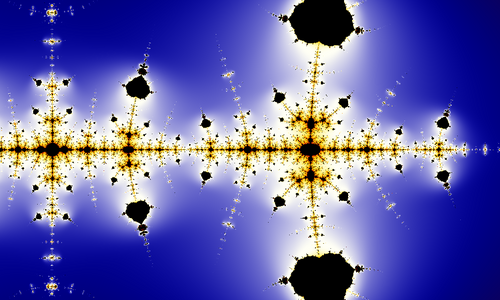 But here it is based on exact numbers. Just like tree made of numbers and it do looks like l-system.  |
|
|
|
|
Logged
|
fractal catalisator
|
|
|
|
Alef
|
|
« Reply #9 on: March 31, 2012, 07:53:33 PM » |
|
This is last picture enlarged:  Take any natural number n. If n is even, divide it by 2 to get n / 2. If n is odd, multiply it by 3 and add 1 to obtain 3n + 1. Repeat the process indefinitely. The conjecture is that no matter what number you start with, you will always eventually reach 1. The property has also been called oneness. If you prove it: Paul Erdős said, allegedly, about the Collatz conjecture: "Mathematics is not yet ripe for such problems" and also offered $500 for its solution. Cheep  |
|
|
|
|
Logged
|
fractal catalisator
|
|
|
|
kram1032
|
|
« Reply #10 on: March 31, 2012, 08:01:41 PM » |
|
|
|
|
|
|
Logged
|
|
|
|
fractower
Iterator
Posts: 173
|
|
« Reply #11 on: April 01, 2012, 08:52:03 AM » |
|
The Algebraic Integers images from Kram1032 remind me of xray scattering of a crystal. It would be interesting to see what it looks like in Fourier space.
|
|
|
|
|
Logged
|
|
|
|
|
kram1032
|
|
« Reply #12 on: April 01, 2012, 11:33:49 AM » |
|
Crystal structures can be thought of as hyperspaces where you cut through with a 3-space in any given angle. If you only track the integer values of the original hyperspaces, you basically get any possible (pseudo)crystaline structure... So it's kind of obvious that they also are some sort of integer fractal.
Penrose tiling is one example of the more interesting ones.
Seeing those images above in fourier space would be interesting indeed and I already wondered about that myself.
Googling that did give me some potentially interesting things but it lead to papers that aren't freely available...
|
|
|
|
« Last Edit: July 07, 2012, 12:39:40 PM by kram1032 »
|
Logged
|
|
|
|
|


 two b&w 3d fractals
3D Fractal Generation
two b&w 3d fractals
3D Fractal Generation
 August 25, 2007, 12:16:05 AM


 Dilber MC Theme by HarzeM