|
Chillheimer
|
 |
« on: February 16, 2016, 01:57:55 PM » |
|
Let's start a little discussion here..  just one small constraint I'd like to put up: Fractals that manifest in real life probably always are finite due to the "limited resolution" of the stuff that they are made of. So the question is not about theoretical mathematical fractals that are infinite but about the real world that we are living in. What are the main arguments that speak against fractal cosmology? |
|
|
|
|
 Logged
|
--- Fractals - add some Chaos to your life and put the world in order. ---
|
|
|
|
Kalles Fraktaler
|
|
« Reply #1 on: February 16, 2016, 03:25:25 PM » |
|
Fractal in the meaning of iterations of simple processing making up complex structures?
Or in the meaning of spontaneous complex patterns at the border between order and chaos?
|
|
|
|
|
Logged
|
|
|
|
hobold
Fractal Bachius

Posts: 573
|
|
« Reply #2 on: February 16, 2016, 03:44:54 PM » |
|
Thus far, it seems as if nature always tries to either minimize or maximize a particular energy in a particular situation. Sometimes fractals are the apparently best way to reach an optimum. Sometimes fractals are an emerging intermediate step while moving from non-optimum to a non-fractal optimum (e.g. turbulent vortexes in a streaming liquid that will later reach a calm equilibrium).
Sometimes non-fractal structures are the optimal solution (e.g. soap bubble surfaces).
Not sure if that is really a strong argument, because it is primarily about developments in time, not about structures in space.
|
|
|
|
|
Logged
|
|
|
|
|
0Encrypted0
|
|
« Reply #3 on: February 16, 2016, 03:55:12 PM » |
|
Is there one fractal propagating through reality or multiple competing fractal processes?
Is the fractal finite because the material is finite?
Just asking.
|
|
|
|
|
Logged
|
|
|
|
|
Chillheimer
|
|
« Reply #4 on: February 16, 2016, 04:24:16 PM » |
|
Fractal in the meaning of iterations of simple processing making up complex structures?
Or in the meaning of spontaneous complex patterns at the border between order and chaos?
for me these are two sides of the same coin. but if you'd like to choose one for an answer, feel free to choose .... e.g. turbulent vortexes in a streaming liquid that will later reach a calm equilibrium
I'd file that under the case of 'limited resolution'. Because as you are nearing the equilibrium you would have to zoom into smaller and smaller deviations from equilibrium. And as your minimum resolution is the individual atoms, you can't zoom further. I don't know if it would be correct to bring up Heisenbergs uncertainty principle here.. Sometimes non-fractal structures are the optimal solution (e.g. soap bubble surfaces).
True, BUT: A single bubble might be not obviously fractal, but take lots of bubbles in all sizes like in foam, and you have fractal self-similarity. So the single bubble might be considered the smallest resolution of a fractal foam.. (?) Not sure if that is really a strong argument, because it is primarily about developments in time, not about structures in space.
fractals aren't restricted to phenomena in space but theres plenty examples of 'time-fractals'. so if your argument is wrong, that would not be the reason Is there one fractal propagating through reality or multiple competing fractal processes?
I say that it is definitely a multifractal construct connected by interaction. Is the fractal finite because the material is finite?
yep, that's another way to put my constraint in the first post. |
|
|
|
|
Logged
|
--- Fractals - add some Chaos to your life and put the world in order. ---
|
|
|
hobold
Fractal Bachius
Posts: 573
|
|
« Reply #5 on: February 16, 2016, 05:35:11 PM » |
|
I don't know if it would be correct to bring up Heisenbergs uncertainty principle here..
I am unsure if Heisenbergs Uncertainty Principle is really about ... unknowability, or about the actual absence of information. For us, there would not be a practical difference, but for the universe it would be the difference between, one the one hand, a strict order way too small to ever be seen, and on the other hand, pure chaos, a source of truly random bits, but with too little bandwidth to cause much harm on the macroscopic scale. In the former case, there might or might not be fractals down there, but we can never see them. In the latter case, everything and nothing is down there, but whatever we seem to be seeing is only a mirage. On a more general note, I see a danger that you (Chillheimer) are arguing in a circle. If you define everything to be fractal, then you will inevitably draw the conclusion that everything is fractal. It may well be that this is ultimately a correct conclusion, but you should try not to impose it on every little piece of evidence right away. Doing so robs you of the ability to recognize contradictory observations, and ultimately limits the insights you can gain. I admit it is difficult, almost non-human, not to judge. But you asked a fresh question, so you should gather data with an impartial mindset. The distinction between "good" and "bad" data is a separate subsequent step of the scientific method. (No offense intended! It's an interesting question.) |
|
|
|
|
Logged
|
|
|
|
|
Chillheimer
|
|
« Reply #6 on: February 16, 2016, 06:19:22 PM » |
|
On a more general note, I see a danger that you (Chillheimer) are arguing in a circle. If you define everything to be fractal, then you will inevitably draw the conclusion that everything is fractal.
Well observed. I definitely am in that danger and am aware of it some of the time and forget it other times - so thank you for reminding me. Absolutely no offense taken! I'm actually happy that you brought this up.. As you say, it is very hard not to become judgmental when you spend lots of time focussing research on one topic. And as you've probably noticed, I'm already pretty much convinced that everything is fractal. so yeah.. It may well be that this is ultimately a correct conclusion, but you should try not to impose it on every little piece of evidence right away.
you're absolutely right. actually, this was part of my intention why I started this thread. After collecting "all" the evidence that speaks FOR fractal cosmology, it is time to find the evidence that speaks against it. The stuff I have found on my own so far didn't really seem valid to me or has already been proven wrong. (I'll get back on this later in the thread, I don't want to spoil other answers) So I hope there will be many posts of good evidence here. (that I then get a chance to refine my argumentation with) I' might get back on the bubble point, but from a different angle. (in short: soap bubbles pop through evaporation. It reminds me of a reversed bifurcation diagram. entropy gets removed through evaporation, and when there is none left, the bubble pops.) it was just that this pic 'popped' in my mind, as soon as you mentioned bubbles.. 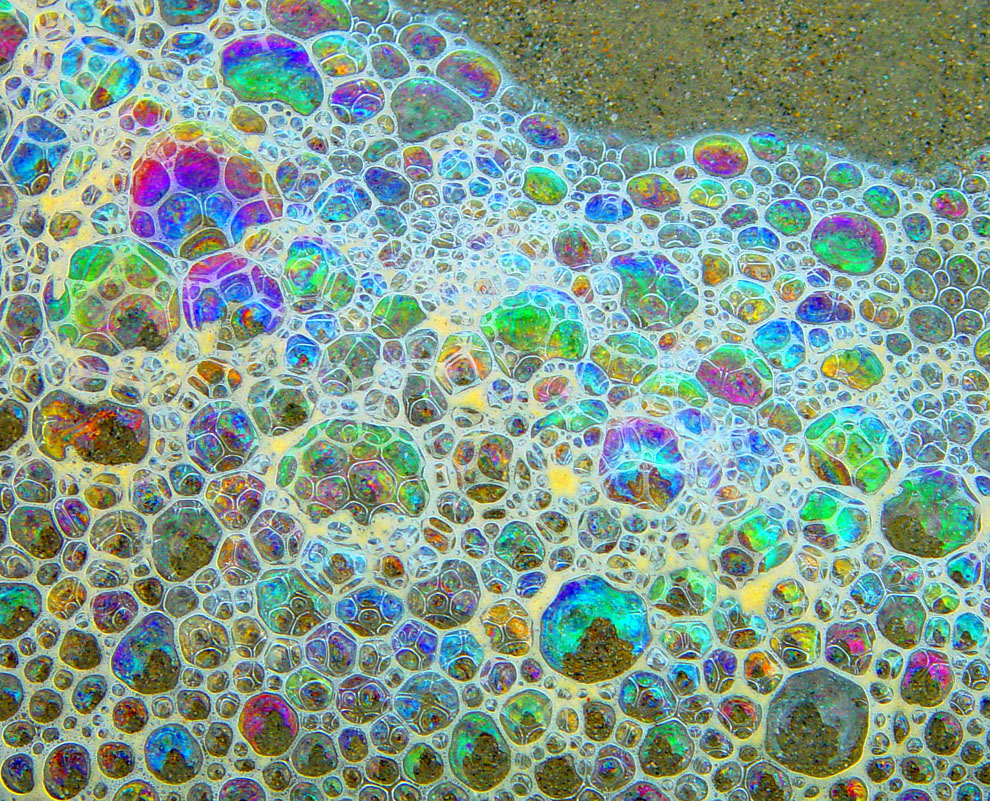 and to me that is clearly fractal.. |
|
|
|
|
Logged
|
--- Fractals - add some Chaos to your life and put the world in order. ---
|
|
|
lkmitch
Fractal Lover

Posts: 238
|
|
« Reply #7 on: February 16, 2016, 06:32:38 PM » |
|
Interesting picture of the bubbles--fractals (at least, 3d fractals) tend to maximize surface area, but each bubble minimizes surface area (within some constraints). In what sense might a fractal blob of bubbles (like an Apollonian gasket) be optimal?
|
|
|
|
|
Logged
|
|
|
|
|
zebastian
|
|
« Reply #8 on: February 16, 2016, 07:36:32 PM » |
|
Imho: Seems paradox, but when you look at the thickness of the bubblewalls both fractals and bubbles minimize overall wall Volume. The fractal part comes into play when the system tries to bring itself in the most relaxed State, while starting from a random Start and ordering itself. Apollonian gasket could be a structure with low density and high strength, maybe even (sub)optimal.  |
|
|
|
|
Logged
|
|
|
|
|
Sockratease
|
|
« Reply #9 on: February 16, 2016, 11:16:48 PM » |
|
To me there are 2 major things that argue against a fractal universe (apart from, as you said, the finite nature of "stuff"). First is that it is very difficult to define just exactly what a fractal is! I have seen that discussion here often where people are asking if something is or is not a fractal. And there is often disagreement. People have told me that the images I put in orbit traps and other forms of "exotic projection" are not fractals. But if there is any one thing, anywhere, that is not a fractal - then the universe is not a fractal. It cannot be a fractal and contain things that are not fractal - at best it can be partially fractal. Or, as I say - created using iterative processes - but not all iterative processes are fractal. The second one is the big one. I just don't believe it!! My gut instinct says no. I have no need to support that with logic or reason because it is a matter of Faith. Since any question about the nature of the entire universe can never be answered categorically, all one has after examining all the evidence at hand is their own faith in their own conclusions. It's similar to religion. Many questions can never be answered, but people believe their answers to be true and their faith is all they need. Proof, or even questioning their beliefs, is irrelevant. Their belief in their answers is unshakable. So the universe is not a fractal and god is a Flying Spaghetti Monster! And nobody will ever be able to change my mind on either of those points. |
|
|
|
|
Logged
|
Life is complex - It has real and imaginary components. The All New Fractal Forums is now in Public Beta Testing! Visit FractalForums.org and check it out! |
|
|
Tglad
Fractal Molossus
Posts: 703

|
|
« Reply #10 on: February 17, 2016, 02:14:14 AM » |
|
I think there are two different questions here:
Is lots of the universe made of fractal structures?
A: sure, mainly because fractal geometry generalises euclidean geometry.
Is the universe itself one big fractal?
A: Interestingly nearly all of the standard model of the universe is conformal. And I suspect the bits that aren't are the bits that are not finished yet. And the Invariant Set Hypothesis (which does a good job of explaining the weirder aspects of quantum theory) basically proposes that it is a big fractal (well, an invariant set, which is more or less the same thing).
My only evidence against is if you use too narrow a definition of fractal. For instance the universe is not conformal in Euclidean space, due to Lorentz boosts / relativity.
|
|
|
|
|
Logged
|
|
|
|
|
Chris Thomasson
|
|
« Reply #11 on: May 30, 2016, 10:01:01 PM » |
|
Let's start a little discussion here.. just one small constraint I'd like to put up: Fractals that manifest in real life probably always are finite due to the "limited resolution" of the stuff that they are made of. So the question is not about theoretical mathematical fractals that are infinite but about the real world that we are living in. What are the main arguments that speak against fractal cosmology? Humm... The atomic nature of things comes to mind wrt zooming in forever on a point. So, perhaps its fractal up to a point. You zoom down to Plank voxels, try to zoom and end up going back to where you started, like an unsigned integer wrapping back to zero. Is this total non-sense? Speaking of that, well: FWIW, I have always had the feeling that our universe resides within a super massive black hole branching out from our “parent” universe. Think of viewing slices of a cosmic tree in a volumetric rendering where the knots in the wood represent complex branching/buds. Knots in wood seem to resemble black holes with field lines: http://i.stack.imgur.com/k9rGB.jpgThis means that our universe has many children. I do not know where this tree came from, perhaps it was never created, and will never die. Well, I hope I did not go too far out into KookVille... Sorry. Perhaps its fractal when you zoom _out_, not zoom in. Humm...  |
|
|
|
|
Logged
|
|
|
|
|
Max Sinister
|
|
« Reply #12 on: May 31, 2016, 07:45:05 PM » |
|
My two cents: Most of the universe is empty space, and empty space certainly isn't a fractal.
|
|
|
|
|
Logged
|
|
|
|
|
Chris Thomasson
|
|
« Reply #13 on: May 31, 2016, 09:24:46 PM » |
|
My two cents: Most of the universe is empty space, and empty space certainly isn't a fractal.
FWIW, I think empty space is not actually made of nothing: http://science.nasa.gov/astrophysics/focus-areas/what-is-dark-energy/Dark energy/matter just might have some fractal properties; nature seems to be full of these. Humm... Some people think that there is nothing inside the non-escaping MSet, however there is an internal structure. |
|
|
|
|
Logged
|
|
|
|
|
Chillheimer
|
|
« Reply #14 on: May 31, 2016, 10:27:55 PM » |
|
@max: but to use this analogy: if you zoom into the mandelbrot set, the empty areas (a 2d plane) expand more and more too. while the actual border stays a "1d" line, so the ratio between empty space and the border (or the tiny black parts that are actually part of the mandelbrot set) gets more and more shifted towards empty space. just as empty space, the empty areas (going to infinity) in the mandelbrot set are not fractal. but that is not what the mandelbrot-set is about. Everything there actually IS in that emptiness(and that is worth talking about) is the fractal border, the pictures we enjoy so much. same in the universe imho. as I might have mentionen here and there before, I believe that we are surfing the fractal border between 3d-space and 4d-time - just like a zoom into the mandelbrot set is surfing the border between 2d space and a 1d straight line. Well, I hope I did not go too far out into KookVille... Sorry.
nope we had far worse.. some of it probably by myself.  and regarding black holes and fractals, you might enjoy this: https://www.newscientist.com/article/dn25472-turbulent-black-holes-grow-fractal-skins-as-they-feed/and there's a good (but difficult) talk by susskind on this on youtube |
|
|
|
« Last Edit: May 31, 2016, 10:36:12 PM by Chillheimer »
|
Logged
|
--- Fractals - add some Chaos to your life and put the world in order. ---
|
|
|
|


 January 31, 2011, 12:23:55 AM


 Dilber MC Theme by HarzeM